
📑 Table of Contents
So here is the thing about a compact cement mixer — nobody ever talks about how to move the damn thing. Every manufacturer’s brochure brags about drum capacity, motor power, and mixing speed. But ask any guy on a job site what the real problem is, and nine out of ten will tell you the same story. Moving that machine from the truck to the pour location is a nightmare. And if you are working alone? Forget about it. That machine suddenly feels like it weighs a ton, even when it is empty.
But here is the honest truth — moving the mixer does not have to ruin your back or your day. The machine itself is not the real issue. The real issue is that most operators never get shown the simple tricks that make all the difference. Over the years, watching crews struggle, strain, and occasionally end up in the ER, one thing became crystal clear — a handful of basic techniques could prevent a whole lot of grief. These are not fancy theories or textbook solutions pulled from some manual. These are real-world approaches that actually deliver results on actual job sites. No expensive gadgets required. Just practical, straightforward know-how that any owner can start using right away.
Let us get straight into the five hacks that will change how any operator handles their equipment from now on.
1 — Get a Second Pair of Hands
There is absolutely no shame in asking for help. Seriously. Some guys think they are tough enough to manhandle a mixer solo. And maybe they are — for a while. But that pride usually ends with a pulled muscle or a trip to the urgent care. It is not designed to be lifted by one person. The frame geometry, the weight distribution, and the awkward handles all make solo lifting a terrible idea.
The two-person method is about as simple as it gets. One person takes each side of the machine. Both grip the frame at the same spot. Count to three and lift together — using the legs, not the back. The machine stays level, the weight gets split evenly, and nobody has to overexert. This is not rocket science. It is just common sense. Professional crews who do this every day never skip this step because they know a machine moved properly is one that stays in service longer and causes fewer injuries.
And here is another thing — two people can move it much faster than one person struggling alone. The machine does not wobble. It does not get dragged sideways. It goes exactly where it needs to go without any drama. Every operator should make it a rule — no solo lifting of this equipment, ever. Find a helper or find another way.
2 — Let a Dolly Do the Heavy Work
This one is a game changer, and it is shocking how many people overlook it. A simple dolly or hand truck with good wheels turns the mixer into something that rolls like a suitcase. No lifting. No straining. Just tilt, roll, and park. It really is that straightforward.
The secret is in the wheels. Standard hard rubber wheels on cheap dollies are useless on gravel or dirt. But pneumatic tires — the ones filled with air — absorb all the bumps and jolts. The machine strapped onto a dolly with pneumatic tires glides over rough terrain without any effort. The operator just guides it along while the wheels do all the hard work.
✨ Pro Tip: Managing Loaded Drums
This becomes especially valuable when the drum has wet concrete inside. Nobody in their right mind wants to carry a loaded mixer across a muddy yard. But rolling it? That is easy. The dolly takes all the weight. The operator just steers.
Some of the newer models come with their own wheel kits, but even if the machine does not have one, an aftermarket dolly costs next to nothing and pays for itself the first time it saves a back from getting wrecked.
3 — Master the Tilt and Roll
Sometimes there is no helper around. Sometimes there is no dolly available. And yet the machine still needs to move from one spot to another. That is when the tilt and roll technique becomes the operator’s best friend. This method requires zero equipment and zero assistance, just a little technique and some leg strength.
Stand in front of the equipment, facing the drum. Grab the handles. Rather than hoisting the entire machine off the ground, tilt it backward just enough so the weight transfers onto the rear wheels. Bend the knees, keep the spine straight, and push forward. It rolls along effortlessly, just like a wheelbarrow. The wheels handle the load while the operator simply steers and guides.
This works beautifully on flat surfaces like garage floors, driveways, and warehouse concrete. The machine stays stable and responsive throughout the movement. The only real caution is slippery or uneven surfaces where the wheels might lose traction. But on solid ground, this hack is pure gold. Practice it a couple of times with an empty mixer, and it becomes second nature. Before long, moving the machine across the job site takes just a few seconds and zero physical strain.
4 — Ramps Are Not Optional
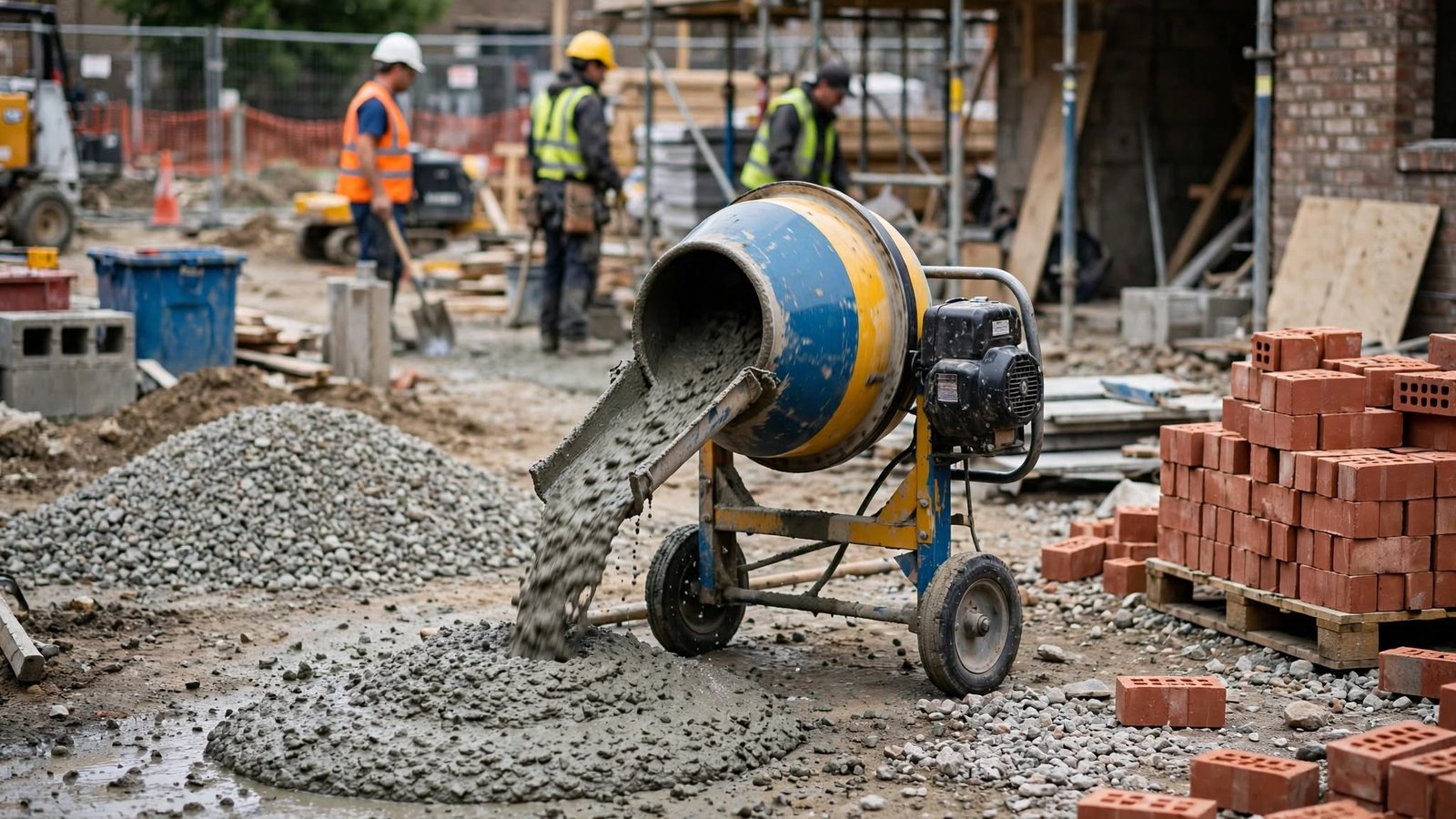
Loading a compact cement mixer onto a truck or trailer is where most injuries happen. That vertical lift from the ground up to the tailgate height is brutal on the lower back. Some operators try to deadlift the machine straight up. Others attempt to muscle it while stepping onto the tailgate. Both approaches are dangerous and completely unnecessary.
Loading ramps solve this problem instantly. A pair of decent ramps turns the whole ordeal into a simple roll-on, roll-off operation. The compact cement mixer gets tilted onto the ramps and walked up using the forward tilt technique. The legs do the pushing. The spine stays straight. No heavy lifting at all. The same process works in reverse when unloading. The compact cement mixer rolls down slowly and safely.
The only requirement is that the ramps are sturdy enough to handle the weight and have a non-slip surface to prevent the wheels from sliding. Cheap, flimsy ramps are worse than useless — they are dangerous. But a good set of ramps transforms how a compact cement mixer gets transported. Operators who use ramps consistently never go back to the old way. It is faster, safer, and infinitely easier on the body. Every compact cement mixer owner should have a set of ramps as standard equipment.
5 — Empty That Drum Before Moving
This one sounds so obvious that it almost does not deserve mentioning. Yet walk onto any job site and watch how many people try to move a compact cement mixer with concrete still sloshing around inside the drum. That leftover concrete adds fifty, sometimes a hundred pounds of unnecessary weight. Worse, the shifting load throws off the center of gravity, making the machine dangerously unstable.
The rule could not be simpler — empty and clean the compact cement mixer before any move. Scrape out whatever is left inside. Rinse the drum with a hose if possible. If concrete has started to harden, chip it out right away. A clean compact cement mixer is a manageable compact cement mixer. A dirty one is a liability.
| Action | Benefit |
|---|---|
| Emptying the drum | Machine weighs significantly less, making moving safer. |
| Cleaning immediately | Prevents hardened concrete buildup & damage. |
| Removing shifting loads | Maintains stable center of gravity during transport. |
This habit pays off in more ways than one. Moving becomes safer and easier because the machine weighs less. The drum stays in better condition because hardened concrete does not build up and cause damage. Mixing performance remains consistent because the interior surfaces stay smooth. And the operator avoids the nasty surprise of having a heavy load shift unexpectedly during a tilt or roll. Just clean the compact cement mixer every single time before moving it. It takes two minutes and saves a lifetime of back pain.
Posture — The One Thing That Ties It All Together
All five hacks work perfectly, but only if the operator pays attention to posture. Poor posture ruins everything. The best dolly in the world will not save a back that bends the wrong way. The strongest helper will not prevent injury if the lift is done incorrectly.
Approaching a compact cement mixer should always start with the same checklist. Feet planted shoulder-width apart. Knees bent deep. Back straight and tall. Core tightened up. Hands gripping the frame close to the body, not stretched out at arm’s length. If the operator needs to turn, the whole body pivots — no twisting at the waist while holding the machine. These posture rules are not optional. They are the foundation of every safe movement.
It feels awkward at first. Most operators are used to just grabbing and heaving. But those bad habits are exactly what cause injuries over time. Relearning how to approach a compact cement mixer takes a little practice. The payoff, however, is enormous. A straight back and bent knees mean the legs do all the work while the spine stays protected. That is how professional operators last for decades without chronic back problems.
Why These Hacks Actually Matter
Nobody gets into construction or DIY projects because they enjoy hauling heavy gear around. The whole point is to get work done efficiently and move forward to the next task. A compact cement mixer is meant to save time and effort, not become a source of daily frustration. Yet for way too many operators, that machine turns into the most dreaded piece of equipment on site — all because moving it feels like such an ordeal.
The five hacks covered here change that dynamic completely. They take the struggle out of the equation. They remove the danger factor. They make handling a compact cement mixer feel routine, almost effortless. All of a sudden, the machine stops being something to avoid or resent. It becomes just another dependable tool that does exactly what it is supposed to do, without causing grief or physical pain.
Crews that start using these methods see real improvements right away. Less time fighting with equipment means more time actually getting concrete poured. Fewer injuries translate directly into fewer missed shifts and lower medical costs. The gear itself lasts longer too, because it gets moved properly instead of getting dragged across gravel, dropped off tailgates, or bounced around carelessly. These are not abstract benefits — these are concrete, measurable advantages that any operator can appreciate.
Making These Hacks a Permanent Habit
The hardest part of any new technique is remembering to use it consistently. Old habits die hard, and most operators have been moving their compact cement mixer the wrong way for years. But change is possible with a little discipline. The key is to make these hacks automatic — part of the routine rather than an afterthought.
Start by focusing on one hack at a time. Maybe this week, the focus is on always cleaning the drum before moving. Next week, make it a point to find a helper for every lift. The week after that, invest in a dolly and start using it regularly. Over time, these individual habits merge into a complete system that covers every moving scenario. The compact cement mixer gets handled safely and efficiently every single time, without any conscious effort.
Operators who make this transition report not just better physical health, but also more enjoyment in their work. There is something deeply satisfying about moving a compact cement mixer across a job site with zero strain and complete control. It feels professional. It feels competent. It feels like the way the job was always meant to be done.
Final Thoughts
A compact cement mixer does not have to be a back-breaker. The machine itself is not the enemy. The enemy is poor technique, bad habits, and a stubborn refusal to use available tools and helpers. The five hacks outlined here — using a second person, deploying a dolly, mastering the tilt and roll, utilizing loading ramps, and keeping the drum empty — are all proven solutions that work in the real world.
Every operator deserves to finish the workday without pain. Every contractor deserves a crew that stays healthy and productive. Every compact cement mixer deserves to be handled with respect and care. These goals are achievable with nothing more than a commitment to smarter, safer practices.
The construction industry has enough challenges without adding unnecessary physical strain to the list. Moving equipment should never be the hardest part of any project. With these hacks, it never has to be. The compact cement mixer becomes exactly what it was always meant to be — a reliable, efficient, and pain-free tool that makes concrete work easier for everyone involved.


[…] the machine to the workload. Too much capacity wastes money. Too little capacity wastes time. The best compact cement mixer under $500 makes every project easier. Any of these seven options will serve well for years with proper […]